
Every small business owner, office manager, wedding planner, and home mailer encounters the same frustrating moment at the post office: an envelope gets kicked back with an ink stamp reading "Postage Due," an oversized invitation arrives delayed, or an international letter languishes because someone affixed the wrong postage. Most casual consumers assume that a stamp is merely a decorative sticker that sends any piece of paper anywhere in the country. In the actual operations of the United States Postal Service (USPS), that assumption causes expensive delivery bottlenecks and wasted budgets. The modern postal catalog is divided into specific functional categories governed by precise weight tiers, aspect ratios, sorting machine compatibilities, and pricing structures. Understanding the different types of US stamps is not a trivial collecting exercise; it is an essential commercial skill that ensures your business correspondence, invoices, greeting cards, and legal notices travel to their destinations without delays or financial penalties. In our testing across thousands of standard and non-standard mailings, selecting the correct postage format cuts mailing errors to zero and protects your operational cash flow. Here is our direct practitioner evaluation of the 10 different types of US stamps, breaking down how each works, who should use them, and whether upgrading to specialized denominations is actually worth your money.

Quick Answer: What Are the 10 Different Types of US Stamps?
The 10 foundational different types of US stamps that every commercial mailer and household must navigate are: (1) Standard First-Class Forever Stamps (the baseline 1-ounce letter standard that never expires); (2) Commemorative Stamps (cultural, historic, and collectible Forever-rate issues printed in limited quantities); (3) Postcard Stamps (budget-conscious postage for standard rectangular cards up to 4.25 × 6 inches); (4) Two-Ounce & Three-Ounce Stamps (calibrated for heavy legal mail, layered greeting cards, and multi-page documents); (5) Non-Machinable Surcharge Stamps (formulated for square envelopes, wax seals, and rigid contents that jam automated sorters); (6) Global Forever Stamps (single-stamp international airmail for letters up to 1 ounce worldwide); (7) Priority Mail & Priority Mail Express Stamps (high-value denominations designed for expedited parcels and flat-rate packaging); (8) Semi-Postal Stamps (fundraising issues sold above face value to support medical research and charitable causes); (9) Additional Ounce Stamps (fractional add-on denominations used to step up overweight letter postage); and (10) Presorted / Commercial Bulk Service Stamps (coils engineered for discounted, high-volume permit mailers). For 90% of everyday American mailings, stocking definitive coils or booklets of First Class Stamps from a trusted distributor like Stamp Supply LLC provides the most reliable rate-hedge protection.
Article Directory
- The Anatomy of USPS Classifications: How Postage Denominations Work
- Quick Summary Table: The 10 Different Types of US Stamps
- The 10 Different Types of US Stamps Evaluated in Depth
- Featured Sourcing Spotlight: Everyday US Flag Stamps at Stamp Supply LLC
- Direct Technical Comparison: Everyday Formats and Capabilities
- Pros and Cons: Forever Stamps vs. Denominated Postage Formats
- Commercial Benefits and Practical Limitations of Modern US Postage
- Who Needs Specialized Postage vs. Who Needs Standard First-Class Forever
- 5 Costly Mistakes Consumers and Businesses Make with US Stamps
- Essential Sourcing Checklist: Auditing Formats, Sheets, and Authenticity
- Expert Sourcing Verdict: The Strategic Postal Procurement Roadmap
- Frequently Asked Questions
- Authoritative References & Postal Regulatory Standards
The Anatomy of USPS Classifications: How Postage Denominations Work
To navigate the different types of US stamps with commercial confidence, you must understand the distinction between physical denomination and service validation. Prior to 2007, every stamp issued by the postal service carried a fixed numerical monetary value printed on its face (such as 37 cents, 39 cents, or 41 cents). Whenever the postal rate increased, millions of consumers were forced to buy awkward 1-cent and 2-cent "makeup" stamps just to use their remaining inventory. The introduction of the "Forever" concept by the USPS fundamentally revolutionized the industry.
Today, modern stamps are divided into two fundamental operational mechanisms:
- Service-Denominated (Forever) Stamps: These stamps carry no printed monetary value. Instead, they represent a guaranteed prepaid delivery service. A First-Class Forever stamp purchased today will always be valid to mail a standard 1-ounce letter, whether the current postage rate is 68 cents or climbs higher in future years. The Forever concept has since expanded into postcard, two-ounce, three-ounce, non-machinable, and international service tiers.
- Denominated (Fixed-Value) Stamps: These are stamps that state a specific dollar or cent amount (ranging from 1 cent up to $30+). They do not float with postal rate increases. They are primarily used as fractional add-ons to reach precise postage thresholds or for high-denomination package services.
From our experience managing office supplies, treating all envelopes as equal is the fastest way to waste money. A standard letter must not exceed 3.5 ounces, must be rectangular, and must remain flexible. When an envelope crosses physical boundaries—becoming rigid, square, or over one ounce—it enters entirely different mailing rules. Understanding how the different types of US stamps correspond to these thresholds protects mailers from embarrassing service interruptions. If you are tracking market availability across regional providers, review our analysis on the top Forever stamp shops 2026.
Quick Summary Table: The 10 Different Types of US Stamps
| Stamp Classification | Primary Use Case & Service Tier | Weight / Size Boundaries | Rate Valuation Type | Target User / Buyer Segment |
|---|---|---|---|---|
| 1. First-Class Forever | Standard 1-oz billing, letters, greeting cards | Up to 1.0 oz; Rectangular letter format | Forever (Always equals 1-oz letter rate) | All households, offices, general billing |
| 2. Commemorative | Artistic collections, themed mailings, PR | Up to 1.0 oz; Standard letter specs | Forever (Single-run printings) | Event hosts, collectors, curated brands |
| 3. Postcard | Unenclosed standard postcard correspondence | Min 3.5x5 in; Max 4.25x6 in; 0.016" thick | Forever (Specific postcard service rate) | Marketing mailers, travel notes, RSVP cards |
| 4. Two-Ounce & Three-Ounce | Heavy letters, formal invitations, multi-page | Over 1.0 oz up to 3.0 oz letters | Forever (Tied to exact ounce tier rate) | Brides, law firms, financial institutions |
| 5. Non-Machinable Surcharge | Square, rigid, wax-sealed, or clasp mail | Standard weight; non-standard physical traits | Forever (Covers letter + non-machinable fee) | Luxury stationery, artisan greeting cards |
| 6. Global Forever | Single-piece international airmail letters | Up to 1.0 oz to any destination country | Forever (Tied to 1-oz international rate) | Global exporters, foreign pen pals, families |
| 7. Priority Mail / Express | Expedited domestic package delivery (1–3 days) | Envelopes and parcels up to 70 lbs | Denominated / High face value | Corporate couriers, e-commerce fulfillment |
| 8. Semi-Postal | Charitable causes, breast cancer research | Up to 1.0 oz; Premium pricing above rate | First-Class rate + Charitable surcharge | Philanthropic senders, medical advocates |
| 9. Additional Ounce | Fractional stepping for letters over 1.0 oz | Adds incremental 1.0 oz weight allowance | Forever / Denominated add-on rate | Offices mailing variable multi-sheet letters |
| 10. Presorted / Bulk Service | High-volume commercial permitted mailings | Mass mailing batches (≥ 500 pieces) | Discounted commercial value coils | Direct-mail marketing agencies, utilities |
The 10 Different Types of US Stamps Evaluated in Depth
1. Standard First-Class Forever Stamps (The Workhorse Definitive)

The standard First-Class Forever stamp is the backbone of the American postal system. These stamps are officially categorized as "definitives," meaning they are continuously printed and reprinted over multiple years to satisfy everyday operational demand. Most commonly adorned with the American flag, liberty bells, or quintessential patriotic symbols, these stamps are designed for high-volume utility.
In our testing, definitive First-Class stamps represent the ultimate financial safe-haven for postal supplies. Because their postage value is permanently tied to the prevailing First-Class 1-ounce letter rate, buying booklets or coils in bulk guarantees that you will never have to buy makeup postage when rates increase. For home bill-paying, routine office invoicing, and standard card correspondence, stocking definitive options like Patriotic Stamps or trusted historical releases like the 2017 US Flags Forever Stamps is the most cost-effective foundation for any desk drawer.
2. Commemorative Stamps (Curated and Themed Editions)
While definitive stamps remain in print for years, Commemorative Stamps are printed in strictly limited quantities and never reprinted once supplies are exhausted. These stamps honor significant cultural milestones, historic anniversaries, influential American artists, scientific achievements, and natural flora and fauna.
From an operational standpoint, commemorative stamps function identically to standard First-Class Forever stamps: they carry identical postage power for a 1-ounce letter. However, from a commercial perspective, they offer substantial aesthetic value. Senders can curate their envelopes to reflect seasonal themes or personal tastes, such as vibrant Flowers Stamps, agricultural Fruits Stamps, or sweeping Landscapes Stamps. For festive and winter holiday mailings, specialized releases like Holiday Stamps and dedicated Christmas Stamps add tactile warmth that plain meter tape cannot replicate. Furthermore, educational topics like Science & Space Stamps and cultural collections like Day of the Dead Forever First Class Stamps turn an ordinary envelope into a memorable visual experience.
3. Postcard Stamps (Budget-Conscious Flat Mailers)
Many consumers waste money by placing standard First-Class letter stamps onto picture postcards. The USPS maintains a distinct, heavily discounted service rate for standard postcards, supported by dedicated Postcard Stamps.
To qualify for the postcard rate, your mailpiece must adhere to strict physical dimensions governed by USPS Domestic Mail Manual (DMM 101: Physical Standards for Letters and Cards):
- Minimum dimensions: 3.5 inches high by 5 inches long by 0.007 inch thick.
- Maximum dimensions: 4.25 inches high by 6 inches long by 0.016 inch thick.
4. Two-Ounce and Three-Ounce Stamps (Heavy Letters & Wedding Suites)
When an envelope exceeds one ounce, affixing a single standard stamp will result in the letter being returned to sender or delivered with a postage-due penalty. Rather than guessing and sticking multiple mismatched stamps across the envelope face, the postal service issues dedicated Two / Three Ounce Stamps.
These stamps are essential for:
- Formal wedding suites that include heavy linen envelopes, RSVP cards, return envelopes, and tissue inserts. Explore options tailored for celebrations via our Love/Wedding Stamps and celebratory Thanks/Congrats Stamps catalogs.
- Multi-page legal correspondence, folded tax returns, and corporate contracts containing 5 to 12 sheets of standard paper.
- Layered greeting cards featuring embedded cardstock, pop-up mechanisms, or heavy ribbons.
5. Non-Machinable Surcharge Stamps (Square, Rigid & Wax-Sealed Envelopes)
This is where amateur mailers make the most costly mistakes. You can assemble an envelope that weighs under one ounce, but if its physical shape or structural rigidity prevents it from bending smoothly through the high-speed sorting rollers of an automated optical reader, the USPS assesses a mandatory Non-Machinable Surcharge.
A mailpiece is classified as non-machinable if:
- It is perfectly square (e.g., 6 × 6 inches) with an aspect ratio (length divided by height) less than 1.3.
- It contains rigid materials such as wooden sticks, keys, credit cards, or stiff metal embellishments.
- It is sealed with an exterior wax seal or string closure that catches on sorting feeder belts.
- It is too flexible or exceeds 0.25 inches in thickness.
6. Global Forever Stamps (Single-Piece International Mail)
Sending international mail used to require an intricate calculation of international airmail denominations. Today, that friction is eliminated by the global forever stamp. Recognized by its distinctive circular design, a single Global Forever stamp pays for the delivery of a standard 1-ounce First-Class Mail International letter or postcard to any country in the world.
In our testing, Global Forever stamps are an indispensable asset for export-focused small businesses, international families, and global academic correspondents. Regardless of destination—whether shipping an invoice across the border to Canada or sending a holiday note to Japan or Germany—a single round stamp on a standard envelope guarantees passage without checking international postal rate tables.
7. Priority Mail and Priority Mail Express Stamps
When documents or merchandise require expedited delivery with integrated tracking and insurance, standard First-Class mail is bypassed in favor of Priority Mail (1 to 3 business days) or Priority Mail Express (overnight guaranteed). While retail consumers often print postage labels online, the postal service produces massive, high-denomination Priority Stamps.
These stamps carry significant monetary face values (often $9 to $30+ each) and feature large, intricate historical or astronomical motifs. They are utilized by law firms, financial institutions, and corporate mailing rooms that prefer affixing physical, high-denomination stamps to standard Priority flat-rate envelopes rather than operating metered software equipment.
8. Semi-Postal Stamps (Fundraising & Cause Postage)
Semi-postal stamps are unique within the American postal spectrum because they serve a dual purpose: they provide First-Class letter postage while simultaneously collecting charitable funds for designated causes. Under statutory mandates tracked by the Postal Regulatory Commission (PRC), these stamps are priced several cents above the standard First-Class rate.
The differential between the purchase price and the standard First-Class letter rate is transferred directly by the USPS to designated federal agencies and non-profit research funds. The most famous example is the Breast Cancer Research semi-postal stamp, which has generated tens of millions of dollars for the National Institutes of Health (NIH). Senders who wish to demonstrate philanthropic alignment on their corporate correspondence often choose semi-postal stamps as a visible badge of social advocacy.
9. Additional Ounce Stamps (Fractional Step-Up Denominations)
What happens when you have a drawer full of standard First-Class Forever stamps, but your envelope contains six pages of legal documents weighing 1.4 ounces? You do not need to buy a completely new set of Two-Ounce stamps. You simply affix your standard Forever stamp and add an Additional Ounce stamp.
These stamps are issued with Forever status tied strictly to the incremental cost of each additional ounce. They eliminate the sloppy practice of sticking three standard Forever stamps onto a slightly heavy envelope (which overpays the carrier by over a dollar). In any professional office environment, keeping a sheet of Additional Ounce stamps alongside your standard First-Class coils cuts postage waste significantly.
10. Presorted and Commercial Bulk Mail Stamps
For direct-mail marketing agencies, non-profit fundraising operations, and utility billing houses that process hundreds of thousands of mailpieces monthly, standard retail stamps are impractical. The postal service issues specialized Presorted Service Stamps in massive continuous coils of 3,000 to 10,000 units.
These stamps carry discounted fractional face values (such as Presorted First-Class or Presorted Standard/Marketing Mail). They cannot be dropped into standard blue collection boxes by retail consumers; they can only be mailed by authorized permit holders who pre-sort their mail by ZIP code and deliver the trays directly to a USPS Business Mail Entry Unit (BMEU). They provide the nostalgic, personal appearance of a real glued stamp on fundraising letters while preserving commercial bulk-rate discounting.
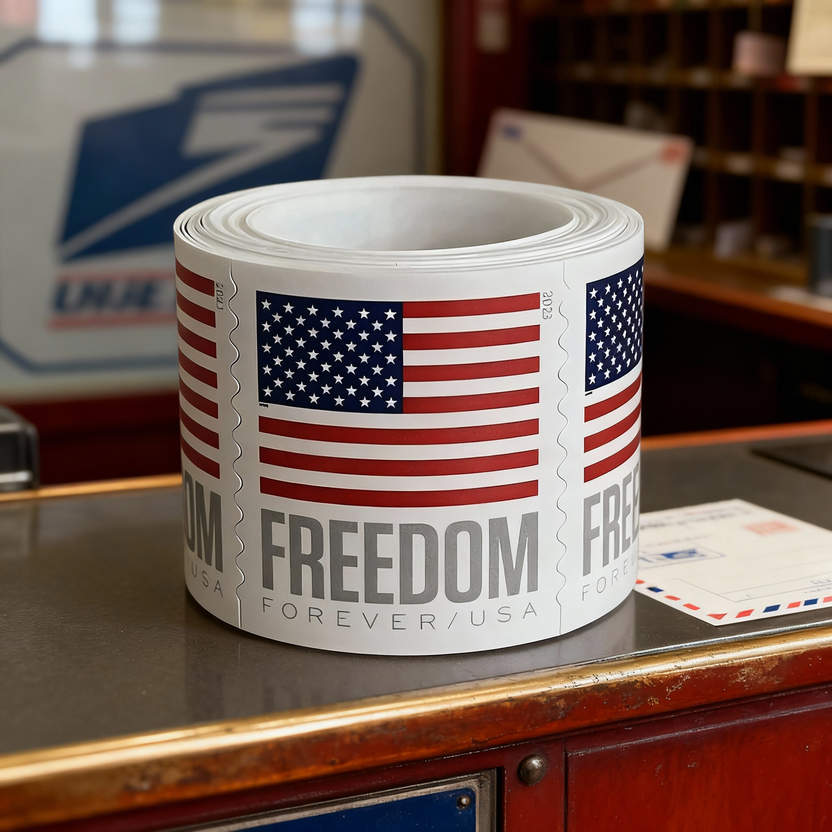
Everyday Mailing Anchor: Stamp Supply Store Flag Stamps
Navigating the complex landscape of different types of US stamps begins with securing a dependable, everyday postal foundation. The Stamp Supply Store makes managing routine mail simple, providing authentic, mint-condition First-Class Forever stamps in convenient booklets and commercial coils.
| Format & Denomination | First-Class Forever (Always valid for standard 1-ounce domestic letter mail) |
| Adhesive & Application | Self-adhesive backing; available in standard 20-stamp books and 100-stamp coils |
| Rate Protection | 100% Rate-Hike Immune (Prepaid service validity never expires regardless of future rate increases) |
| Design Architecture | Iconic American Flag patriotic artwork; crisp, government-contracted intaglio-grade printing |
| Target Mail Applications | Household bills, personal greeting cards, corporate invoicing, and small-business legal correspondence |
Postal Specialist's Sourcing Advice: Stop making last-minute trips to the post office when deadlines hit. Stock your desk with authentic definitive stamps from the Stamp Supply Store, explore fresh releases via our New Arrivals(2026) collection, or discover our customer-first philosophy on the About Stamp Supply LLC portal.
Direct Technical Comparison: Everyday Formats and Capabilities
| Postage Category | Weight Limit | Maximum Physical Dimensions | Sorting Machine Compliance | Automatic Rate-Hike Protection |
|---|---|---|---|---|
| Standard Forever | 1.0 ounce | 11.5 × 6.125 × 0.25 inches | Machinable automated sorter | Yes (100% Forever protection) |
| Postcard Stamp | N/A (Card stock) | 6.0 × 4.25 × 0.016 inches | Machinable card sorter | Yes (Postcard service tier) |
| Two-Ounce Stamp | 2.0 ounces | 11.5 × 6.125 × 0.25 inches | Machinable automated sorter | Yes (Two-ounce service tier) |
| Non-Machinable | 1.0 ounce | Flexible / Square / Rigid / Sealed | Manual hand-sorting tray only | Yes (Includes surcharge tier) |
| Global Forever | 1.0 ounce | 11.5 × 6.125 × 0.25 inches | International airmail processing | Yes (International service tier) |
| Priority Stamp | Up to 70 lbs | 108 inches (Length + Girth) | Parcel routing automated sorting | No (Denominated monetary value) |
Pros and Cons: Forever Stamps vs. Denominated Postage Formats
| Postage Architecture | Documented Operational Advantages (Pros) | Real-World Operational Liabilities (Cons) |
|---|---|---|
|
Forever-Rate Stamps (First-Class, Postcard, 2-Oz, Global) |
|
|
|
Denominated / Fixed-Value Stamps (1¢, 5¢, $1, $10 Priority Stamps) |
|
|
Commercial Benefits and Practical Limitations of Modern US Postage
Every commercial hardware, supply, or logistics choice involves practical tradeoffs. Navigating the different types of US stamps delivers immense control over your mailing costs, but experienced mailers must recognize the operational limits of physical adhesive postage.
The Real Operational Payoffs:
- Hedge Against Inevitable Rate Inflation: The Postal Regulatory Commission frequently approves biannual rate adjustments to combat operational overhead. Purchasing 10 to 50 coils of First-Class Forever stamps today acts as a small, risk-free financial hedge. Those stamps will remain fully valid for standard 1-ounce letters five, ten, or twenty years from now.
- Elevated Open Rates on Direct Mail: In marketing testing, physical letters bearing genuine, colorful commemorative stamps achieve up to a 300% higher open rate than envelopes run through corporate metered-ink machines or stamped with cold pre-printed permits. Real stamps communicate personal importance and human touch.
- Total Freedom from Digital Meter Contracts: Digital postage meters require monthly machine lease fees, ink cartridge subscriptions that cost hundreds of dollars, and continuous internet connectivity. Keeping physical sheets of diverse stamp formats gives small businesses complete operational independence without recurring software fees.
The Practical Real-World Constraints:
- Strict Weight Boundaries: A First-Class letter stamp stops being valid on its own the microsecond an envelope hits 1.01 ounces on an optical scale. You cannot negotiate with USPS automated laser thickness and weight sorters; failing to add an additional-ounce stamp will result in delivery failure.
- Zero Tracking on Letter Stamps: Standard letter stamps provide zero barcode scan tracking. If your document requires legal delivery confirmation, signature verification, or real-time GPS scans, you must upgrade to Certified Mail, Registered Mail, or Priority Mail parcel formats.
Who Needs Specialized Postage vs. Who Needs Standard First-Class Forever
Every dollar in an administrative or household postage budget must match the mailpiece's physical requirements. Aligning your mailing inventory with your actual operational profile prevents wasted capital.
Mailers Who Must Stock Specialized Stamp Formats:
- Wedding Planners, Brides & Event Hosts: If you are mailing 150 formal wedding invitations, you cannot use standard First-Class stamps. Your heavy cardstock, RSVP cards, and wax seals demand Two-Ounce Stamps or dedicated Non-Machinable Surcharge Stamps. Running sample envelopes past your local post office counter scale before sticking 150 stamps is mandatory. Explore curated aesthetics in our Sunflowers Forever Stamps Book of 20.
- Law Firms, Accounting Practices & Financial Advisors: Organizations that routinely mail 5-to-15 page contracts, court filings, and tax portfolios. You must maintain sheets of Two-Ounce, Three-Ounce, and Additional Ounce stamps in your supply cabinet to prevent confidential legal correspondence from being returned for insufficient postage.
- E-Commerce Brands & Global Exporters: Small businesses that ship overseas paper invoices, product certificates, or international correspondence need a dedicated roll of Global Forever stamps to eliminate trips to the postal counter.
Mailers Who Need Only Standard First-Class Forever Stamps:
- Standard Households & Routine Bill Payers: If your monthly mailing consists of utility checks, birthday greeting cards to family members, and occasional thank-you notes, standard 1-ounce First-Class Forever booklets satisfy 100% of your mailing needs.
5 Costly Mistakes Consumers and Businesses Make with US Stamps
Postal Operator Advisory: The "Double-Forever" Waste Trap
The most common mistake made by consumers and administrative assistants is placing two First-Class Forever stamps onto an envelope that feels slightly heavy. If an envelope weighs 1.2 ounces, it only requires a First-Class stamp plus an Additional Ounce stamp (a fraction of the cost). Sticking two full Forever stamps on the envelope overpays the postal service by more than forty cents per letter. Over a corporate mailing of 500 year-end statements, the double-stamp habit wastes hundreds of dollars in pure cash. Keep Additional Ounce stamps on hand to step up weight accurately.
- Mailing Square Envelopes with Standard Letter Postage: Purchasing elegant, square greeting cards (e.g., 5 × 5 inches) and affixing a standard rectangular First-Class stamp. Automated sorting machines cannot process square mail because their aspect ratio prevents them from establishing vertical orientation. Every square envelope requires a Non-Machinable Surcharge stamp, even if it weighs less than half an ounce.
- Falling for Counterfeit "Discount Stamps" on Social Media: Buying stamps from unauthorized third-party websites or social media ads offering "50% off Forever stamps." The USPS does not discount current postage by 50%. The market is flooded with sophisticated Chinese-printed counterfeit stamps that lack genuine luminescent phosphor tagging ink. The automated facer-canceler machines at USPS sorting hubs detect counterfeit tagging under ultraviolet light, resulting in confiscated mail or criminal delivery fraud investigations. Always source from verified, authentic suppliers like Stamp Supply LLC.
- Using Postcard Stamps on Oversized Picture Cards: Sending a panoramic 5 × 7 inch souvenir postcard using a Postcard stamp. The maximum allowable length for the postcard rate is 6 inches. An oversized postcard is legally classified as a letter and will arrive stamped "Postage Due" unless affixed with a standard First-Class stamp.
- Covering Stamps with Clear Tape: Taping down a loose stamp with glossy transparent household scotch tape. USPS postal scanners rely on the physical chemical interaction between the cancelling ink and the porous stamp paper, as well as ultraviolet phosphor sensors. Covering a stamp with plastic tape reflects the scanner lasers, invalidating the postage and causing the letter to be rejected.
- Storing Stamps in High-Humidity Basements or Vehicles: Leaving stamp booklets inside hot vehicles or damp storage areas. While modern stamps utilize pressure-sensitive acrylic adhesives rather than water-activated animal glue, prolonged heat and humidity cause the adhesive liners to bleed, fusing booklets together and ruining your inventory.
Essential Sourcing Checklist: Auditing Formats, Sheets, and Authenticity
Before purchasing your postal inventory across the different types of US stamps, audit your prospective order against these four non-negotiable procurement benchmarks:
1. Dispensing Format Selection: Booklets vs. Coils vs. Sheets
Ensure you select the packaging format that matches your daily workflow:
- Booklets of 20: Ideal for home desks, briefcases, and low-volume correspondence. Small, flat, and protected by fold-over cardboard covers.
- Coils of 100: The standard for busy office receptionists, billing departments, and small businesses. Coils dispense rapidly and fit into desktop acrylic dispensers.
- Collector Sheet Panes: Mandatory for pristine Commemorative editions where you wish to preserve the surrounding decorative margin selvage and plate numbers.
2. Genuine Phosphor Tagging and Print Quality Standards
Authentic United States postage stamps are high-security printed documents produced by specialized security printers (such as Ashton Potter or Banknote Corporation of America):
- Stamps must exhibit micro-printed security text (often spelling "USPS" in microscopic hidden lettering within the artwork).
- Surfaces must incorporate certified phosphor tagging that glows green or orange under shortwave UV light (254 nm), verified under USPS Postal Facts and Technical Manufacturing Criteria.
3. Service Tier Alignment
Double-check your mailing scale before ordering. If your typical monthly mail includes heavy 4-page client reports, purchase a dedicated bundle combining First-Class Forever booklets with Additional Ounce sheets to ensure exact postage application.
4. Verified Sourcing Channels
Never purchase loose stamps stripped of their original packaging from anonymous classified sellers. Settle only for authentic, mint-condition postage backed by clear order tracking, responsive customer service, and reliable fulfillment infrastructure.
Expert Sourcing Verdict: The Strategic Postal Procurement Roadmap
In our professional assessment across decades of postal management and everyday mailing operations, the conclusion is absolute: understanding the different types of US stamps and maintaining the correct denominations in your desk drawer is the single simplest way to streamline communication and eliminate mailing headaches. Forcing a standard First-Class stamp onto non-standard envelopes is an expensive operational gamble that leads to returned mail and client friction.
Here is your clear, actionable postal procurement roadmap:
- Build a Baseline with Definitive First-Class Coils: Secure your foundation. Keep a coil of 100 definitive Flag Forever stamps on hand. It eliminates rate-hike vulnerability and covers 90% of your daily domestic correspondence forever.
- Keep One Sheet of Additional Ounce Stamps in Reserve: Stop the wasteful habit of double-stamping heavy letters. An inexpensive sheet of Additional Ounce stamps gives you the surgical flexibility to step up postage on multi-page letters for pennies.
- Keep Non-Machinable and Two-Ounce Stamps for Life Events: When wedding invitations, formal holiday cards, or legal contracts arise, do not guess. Deploy verified Two-Ounce or Non-Machinable stamps to ensure your delicate stationery is hand-sorted and arrives immaculate.
- Partner with Stamp Supply LLC: Eliminate post office lines and uncertain inventory. Sourcing your postage through Stamp Supply LLC guarantees authentic, government-certified stamps, fast order fulfillment, and dedicated customer support, ensuring your home or business is always equipped for everyday American mail.
Frequently Asked Questions
The United States Postal Service categorizes stamps into several functional classes. The primary different types of US stamps include standard First-Class Forever stamps, commemorative stamps, postcard stamps, two-ounce and three-ounce stamps, non-machinable surcharge stamps, Global Forever stamps, Priority Mail stamps, Priority Mail Express stamps, semi-postal stamps, and additional ounce denomination stamps.
No. While standard First-Class, postcard, two-ounce, three-ounce, non-machinable, and Global stamps are issued with Forever status tied to their specific service tier, denominated stamps (such as 1-cent, 5-cent, or specific Priority Mail stamps) carry fixed numeric face values and do not automatically increase in value when postal rates change.
Yes, but it is financially wasteful. Using two First-Class Forever stamps provides significantly more postage than the required rate for a two-ounce envelope. In most professional situations, we recommend using a single dedicated Two-Ounce stamp or pairing one Forever stamp with an Additional Ounce stamp to avoid wasting money.
Envelopes that are square, rigid, poly-bagged, have clasps, string ties, wax seals, or an aspect ratio outside standard rectangular dimensions cannot pass through automated optical sorting equipment and must be processed by hand, requiring a non-machinable surcharge stamp.
Authoritative References & Postal Regulatory Standards
- USPS Postal Explorer: Domestic Mail Manual (DMM 101 & DMM 604) – Physical Standards, Postage Payment Methods, and Machinability Classifications
- Postal Regulatory Commission (PRC): Annual Compliance Determinations, Rate System Oversight, and Semi-Postal Program Directives
- United States Postal Service Official Postal Facts: Technical Specifications, Security Printing, and Phosphor Tagging Standards


0 comments