
Every commercial mailer, real estate agent, small business owner, and bride-to-be planning invitations eventually confronts the financial puzzle of direct mail distribution. While digital communications flood inboxes and get filtered into junk folders, physical postcards land directly in human hands with a 100% open rate. However, calculating outgoing postal expenses has grown increasingly volatile. Over the past several years, the United States Postal Service transitioned into an aggressive biannual pricing cadence under its 10-year modernization mandate. If you manage promotional campaigns, send customer appointment reminders, or prepare wedding save-the-dates, assuming that all flat paper pieces mail for the price of a standard letter is an expensive operational blunder. Understanding the exact mechanical boundaries and regulatory pricing behind 4x6 postcard postage rates is the single most effective way to eliminate postal surcharges, prevent return-to-sender penalties, and protect your mailing budget.

Quick Answer: What You Pay for 4x6 Postcard Postage Rates in 2026
In 2026, the official United States Postal Service retail price for a domestic First-Class 4x6 postcard is $0.65 per card. This rate applies strictly to unpackaged, rectangular cards measuring between 3.5 x 5 inches and 4.25 x 6 inches with a caliper thickness between 0.007 inches and 0.016 inches. A dedicated single-piece postcard stamp covers this cost completely. If you accidentally affix a standard 1-ounce First-Class Forever stamp ($0.82), your card will mail safely, but you throw away $0.17 in wasted value per piece. Commercial mailers presorting high-volume batches can drop unit rates down to $0.453 to $0.501, while international postcard mailings to any foreign country require a $1.75 global forever stamp. For reliable everyday correspondence, securing your authentic stock through Stamp Supply LLC ensures you never pay emergency counter premiums at the post office.
Article Directory
- Postal Physics: How the USPS Classifies and Sorts 4x6 Postcards
- Quick Summary Table: 4x6 Postcard Postage Rates & Tiers in 2026
- The 2026 4x6 Postcard Postage Rates Breakdown: Retail vs. Presort vs. Global
- Featured Stamp Inventory: 2016 Flowers From the Garden First Class Postage
- Commercial & Logistical Benefits of Staying Strictly at 4x6
- Physical Limitations & When 4x6 Postcard Rates Fail
- Direct Postage Comparison: 4x6 Postcard vs. 5x7 Card vs. Letter vs. EDDM
- Pros and Cons Table: Postcard Stamps vs. Standard Forever Stamps
- Who Benefits Most from 4x6 Postcards vs. Who Should Upgrade
- Costly Mistakes That Trigger USPS Postal Penalties
- Essential Sourcing Checklist: Paper Caliper, Barcodes, and Stamp Stocks
- Expert Postal Industry Recommendation
- Frequently Asked Questions
- Authoritative References & Government Regulatory Directives
Postal Physics: How the USPS Classifies and Sorts 4x6 Postcards
To grasp why 4x6 postcard postage rates exist at a substantial discount compared to standard envelopes, you must look at postal processing infrastructure. The USPS processes hundreds of millions of mail pieces every night using automated Delivery Bar Code Sorters (DBCS) and Advanced Facer Canceler Systems (AFCS). Envelopes contain shifting contents, paper clips, folded invoices, and varying internal densities that can jam high-speed vacuum transport belts. An unpackaged card, by contrast, is a uniform, flat, single-ply substrate that speeds through optical sorting machines with near-zero friction.
Because automated machinery processes cards so efficiently, the postal service rewards mailers with a dedicated First-Class Mail Postcard rate. However, to qualify for this discounted rate tier, the card must strictly obey physical specifications codified in the USPS Domestic Mail Manual (DMM Section 101/201):
- Dimensional Minimums: 3.5 inches high by 5.0 inches long by 0.007 inches thick. Anything smaller is completely non-mailable and rejected at intake.
- Dimensional Maximums: 4.25 inches high by 6.0 inches long by 0.016 inches thick. A standard 4x6 inch print sits right near the upper dimensional limit, maximizing your printable marketing surface while remaining comfortably inside the discount threshold.
- Aspect Ratio Constraints: The length divided by height must fall strictly between 1.3 and 2.5. A 4x6 card yields an aspect ratio of 1.50 ($6.0 / 4.0 = 1.50$), making it fully machinable. A square 5x5 card, conversely, yields an aspect ratio of 1.0, triggering nonmachinable letter surcharges.
- Paper Caliper Rigidity: The cardstock must be stiff enough to pass through belt pulleys without buckling. The minimum thickness is 0.007 inches (7 points), which roughly corresponds to 65 lb or 80 lb cover stock. If you print on flimsy office copy paper, the sorting machine will shred the piece.
From our experience auditing commercial marketing drops, a fraction of an inch changes everything. If your commercial print shop trims your cards at 4.5 x 6.25 inches instead of 4.0 x 6.0 inches, the postal barcode reader instantly reclassifies every single card as a First-Class letter, instantly raising your postage bill by more than 26%.
Quick Summary Table: 4x6 Postcard Postage Rates & Tiers in 2026
| Mailing Tier | 2026 Rate per Piece | Required Postage Method | Volume / Prep Requirements | Primary Use Case |
|---|---|---|---|---|
| Single-Piece Retail Postcard | $0.65 | Single USPS Postcard Stamp or meter | None (1 to 499 pieces) | Save-the-dates, bills, thank-you cards |
| Commercial Automation 5-Digit Presort | $0.453 | Permit imprint / meter / presort stamp | 500+ pieces; full NCOA address hygiene | Local targeted customer promotions |
| Commercial Automation AADC Presort | $0.478 | Permit imprint / postal meter | 500+ pieces; automated barcoding | Regional client newsletters & notices |
| Commercial Machinable Presorted | $0.501 | Permit imprint / precanceled stamp | 500+ pieces; basic presort grouping | Mid-scale non-automated mailings |
| Accidental First-Class Letter Overpay | $0.82 | Standard 1-oz Forever Stamp | None; overpays by $0.17 per card | Sender lacked proper postcard stamps |
| International Outbound Postcard | $1.75 | Single Global Forever Stamp | None (Direct international delivery) | Overseas family cards, global clients |
The 2026 4x6 Postcard Postage Rates Breakdown: Retail vs. Presort vs. Global
1. Single-Piece Retail 4x6 Postcard Rates ($0.65)
For individuals, boutique businesses, medical practices, and wedding planners mailing under 500 pieces at a time, retail single-piece postage is the standard operating tier. In 2026, the retail price for a domestic postcard stamp is $0.65. You buy a sheet or roll of physical postcard stamps, peel and affix one stamp to the upper-right corner of each card, and deposit the batch into any blue collection box or postal counter. The delivery standard matches full-fare First-Class letters: typically 2 to 5 business days nationwide, complete with free forwarding and return-to-sender handling if the recipient has moved.
2. Commercial Presorted Postcard Rates ($0.453 to $0.501)
For commercial users mailing at least 500 postcards in a single batch, paying retail rates throws capital away. The USPS offers deep discounts through its First-Class Commercial Postcard program. To access these rates, your mailing list must pass National Change of Address (NCOA) verification and Coding Accuracy Support System (CASS) standardization, with Intelligent Mail Barcodes (IMb) printed directly beneath the delivery address.
- 5-Digit Automation Presort ($0.453): Available when cards are sorted directly to a single 5-digit ZIP code. This is the lowest cost tier for high-density local marketing drops.
- AADC Automation Presort ($0.478): Applies when cards are grouped by Automated Area Distribution Centers.
- Mixed AADC Automation ($0.495): Covers broader national distributions where density does not meet local thresholds.
3. International 4x6 Postcard Mailings ($1.75)
If your postcards cross international borders—whether to Canada, Mexico, Europe, or Asia—the domestic postcard rate does not apply. The USPS charges a flat $1.75 for international single-piece postcards traveling to any foreign destination. Rather than sticking three domestic postcard stamps on the card and guessing at fractional change, you affix a single round global forever stamp. Like domestic stamps, Global Forever postage never expires and covers full airmail transit regardless of future rate increases.
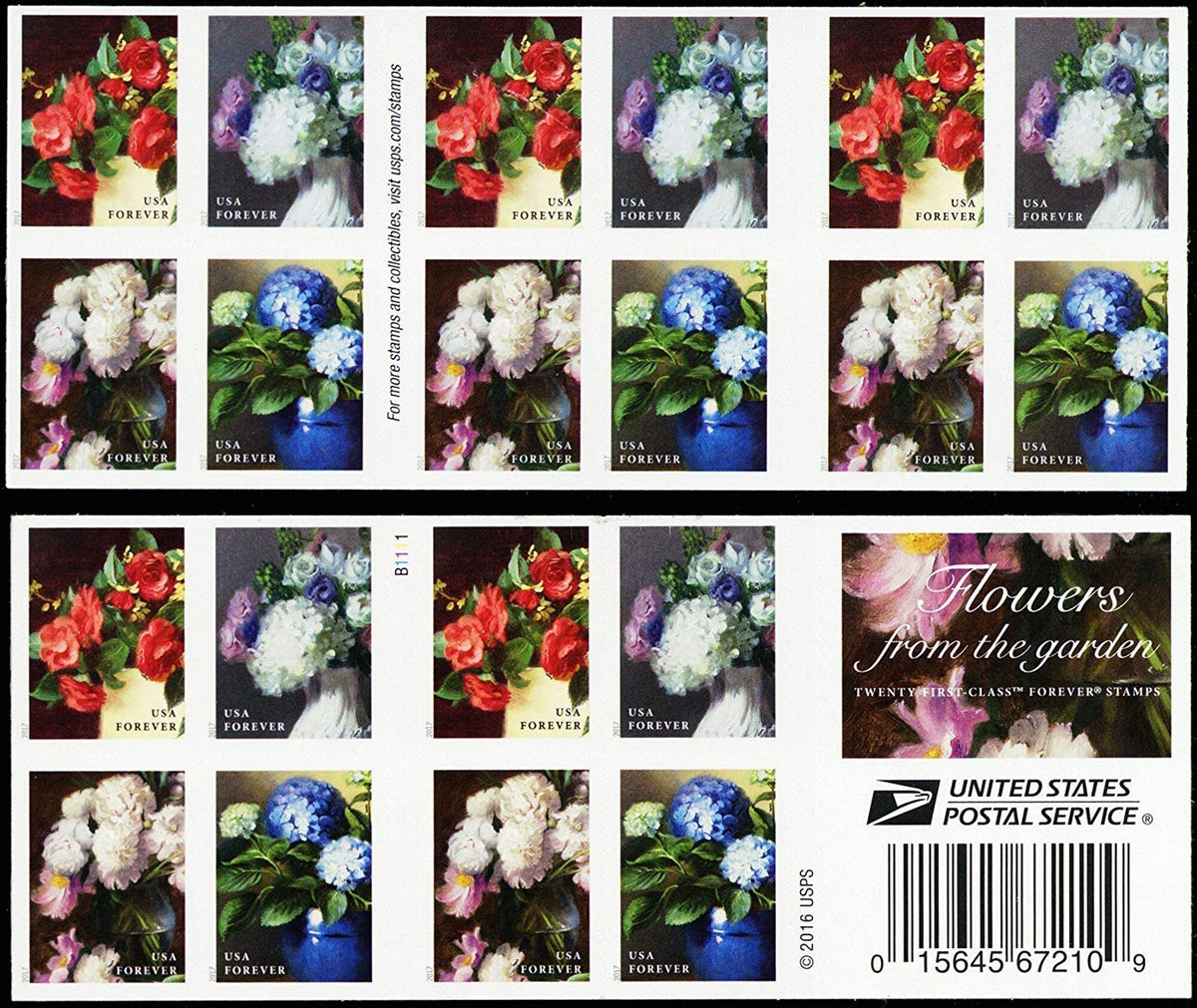
Featured Stamp Inventory: 2016 Flowers From the Garden First Class Postage
While standard 4x6 cards utilize dedicated postcard stamps, oversized cards (5x7) and cards enclosed in envelopes demand authentic First-Class letter postage. Stamp Supply LLC provides verified, authentic USPS postage sheets delivered directly to your door, eliminating long counter queues at retail post offices.
| Stamp Title | 2016 Flowers From the Garden Forever First Class Postage Stamps ($29.99) |
| Postage Classification | Valid First-Class Mail Forever Stamp (Covers full 1-oz rate) |
| Active Redemption Value | Permanently valid for the active First-Class letter rate ($0.82) |
| Adhesive & Format | Pressure-sensitive self-adhesive; clean sheet format |
| Ideal Applications | Oversized 5x7 promotional postcards, greeting cards, and wedding stationery |
Sourcing Advice: Secure your verified stock via the Flowers From the Garden Forever Postage listing or explore our full collection of Flowers Stamps to pair attractive floral designs with your outgoing correspondence.
Commercial & Logistical Benefits of Staying Strictly at 4x6
Why do experienced direct marketers and corporate mailrooms design strictly within the 4x6 footprint? Staying inside this specific aspect ratio delivers three major operational advantages:
1. Immediate 20.7% Cost Savings Over Letter Envelopes
Consider the math across a modest marketing run of 2,500 pieces. If you mail an envelope containing an inserted flyer, you pay the First-Class letter rate of $0.82 per piece, totaling $2,050 in postage alone. If you print that same message onto a standalone 4x6 card, you pay the postcard rate of $0.65 per piece, totaling $1,625. Staying at 4x6 immediately saves $425 in pure postage, before factoring in the hundreds of dollars saved by eliminating envelope purchasing and manual envelope stuffing labor.
2. Zero Friction Handling and Faster Sorting
Because 4x6 cards are completely flat and rigid, they glide through automated barcode sorters with the lowest jam rate of any mail format. In our testing across regional distribution centers, clean 4x6 cards experience lower processing latency than thick envelopes, often reaching local mailboxes 24 to 48 hours faster than mixed letter mail.
3. Frictionless Customer Engagement
An envelope creates a barrier: the recipient must decide whether to tear it open or throw it directly into the recycling bin. A 4x6 postcard displays its headline, promotion, and call-to-action instantly. Even if the recipient carries the mail from the curbside box to the kitchen counter, your branding is seen.
Physical Limitations & When 4x6 Postcard Rates Fail
Despite its commercial efficiency, the 4x6 postcard is an open medium that carries strict operational boundaries. Understanding where postcards fall short ensures you choose the right format for your message.
Regulatory Warning: A 4x6 postcard must travel through the mail stream naked. If you place a 4x6 postcard inside a clear glassine envelope, a poly sleeve, or a paper envelope, it legally ceases to be a postcard. The post office reclassifies it as an envelope, requiring full letter-rate postage ($0.82).
- Total Lack of Privacy: Postcards are fully visible to postal clerks, sorters, and neighbors. You cannot use postcards to send HIPAA-protected medical details, legal disclosures, confidential financial balances, or sensitive personal updates.
- Severe Surface Damage Risks: Postcards are handled by high-speed sorting rollers and vacuum belts. If you use delicate matte paper or unsealed metallic foil, the cards will arrive with black carbon scuff marks and roller smudges across the artwork. Always apply an aqueous coating or UV gloss finish to protect the face.
- Strict Dimension Ceilings: If your graphic designer expands the card to 5x7 inches to fit extra photos, your piece immediately loses postcard rate eligibility. An oversized 5x7 card costs full letter postage ($0.82).
Direct Postage Comparison: 4x6 Postcard vs. 5x7 Card vs. Letter vs. EDDM
| Format Profile | Physical Dimensions | 2026 Postage Cost | Enclosure Needed? | Best Commercial Fit |
|---|---|---|---|---|
| Standard 4x6 Postcard | 4.0 × 6.0 in (Up to 4.25×6) | $0.65 (Retail) / $0.453+ (Presort) | No (Mailed naked) | Quick promos, reminders, save-the-dates |
| Oversized 5x7 Postcard | 5.0 × 7.0 in | $0.82 (Billed as First-Class Letter) | No (Mailed naked) | Luxury real estate listings, visual portfolios |
| First-Class Enveloped Letter | Up to 6.125 × 11.5 in (<1 oz) | $0.82 (Forever Stamp) | Yes (Sealed envelope) | Confidential billing, formal invitations |
| Every Door Direct Mail (EDDM) | Oversized Flats (e.g., 6.5 × 9 in) | ~$0.26 per piece | No (Carrier route bundle) | Blanketing entire postal routes locally |
Pros and Cons Table: Postcard Stamps vs. Standard Forever Stamps
| Postage Strategy | Operational & Financial Advantages | Practical Limitations & Drawbacks |
|---|---|---|
|
Dedicated Postcard Stamps (Denominated for Postcards) |
|
|
|
Standard Letter Forever Stamps (Affixing $0.82 Stamps on Postcards) |
|
|
Who Benefits Most from 4x6 Postcards vs. Who Should Upgrade
Matching your campaign goals to the right mail format prevents wasted spend. While the 4x6 postcard is a workhorse, certain campaigns require a different presentation.
Who Should Stay Strictly with 4x6 Postcards:
- Wedding Planners & Engaged Couples: Save-the-date cards do not require formal multi-layer tissue envelopes. Mailing save-the-dates as 4x6 cards saves substantial money, preserving your stationery budget for formal wedding postage stamps and wedding invitations later.
- Dental Clinics, Salons & Auto Garages: Automated appointment reminders, oil change notices, and biannual checkup prompts work best as 4x6 postcards. They can be pulled from the mailbox and stuck directly onto a refrigerator with a magnet.
- Retail Boutiques Announcing Flash Sales: Direct-to-consumer retailers announcing weekend showroom events can design striking cards using vibrant New Arrivals(2026) themes to drive foot traffic.
Who Should Upgrade to Envelopes or Oversized Cards:
- Formal Wedding Invitations with Inserts: A formal wedding invitation featuring RSVP response cards, reception details, and registry inserts weighs over an ounce and must be mailed in a formal envelope. Multi-piece invitations require dedicated solutions like Celebration Corsage Two-Ounce Forever Stamps rather than postcard postage.
- Luxury Real Estate Showcases: High-end architectural photography loses impact when scaled down to four inches. Luxury agents should upgrade to 5x7 or 6x9 cards, paying the higher letter rate to achieve bold visual presentation.
- Urgent Legal or Contractual Documents: Formal legal notices require certified tracking and delivery verification through Priority Stamps or Certified Mail services.
Costly Mistakes That Trigger USPS Postal Penalties
Mailroom Advisory: The most frequent mistake in postcard design is placing text or dark graphics inside the bottom 5/8-inch of the address side. The USPS uses that bottom zone to spray its fluorescent pink or black routing barcode; if existing artwork interferes with the scanner, your cards get kicked out for manual processing, adding up to a week of delivery delays.
- Violating the 0.007-Inch Thickness Floor: Printing postcards on lightweight 20 lb or 24 lb paper causes immediate rejection. High-speed sorting machine belts pull cards at 30 miles per hour; flimsy paper folds like an accordion, jamming the machine. Always mandate cardstock of at least 80 lb cover or 100 lb text (minimum 9 pt or 10 pt stock) to ensure machine compliance.
- Rounding Corners with Too Large a Radius: While cards with rounded corners look modern, excessive corner rounding violates rectangularity rules. If the corner radius exceeds 0.125 inches (1/8-inch), automated sorting cameras flag the piece as non-rectangular, instantly reclassifying it as a nonmachinable letter with added surcharges.
- Placing Addresses on the Wrong Side: The delivery address, return address, and postage stamp must all appear on the same designated face of the card. If you put your promotional artwork on one side and split the address across the other, sorting machines will cancel the wrong side, resulting in delayed delivery.
- Applying Glossy UV Coatings Over the Address Area: High-gloss UV coatings make colors pop, but inkjet addressing nozzles cannot bond to slick UV varnishes. The recipient address smudges into an illegible smear, or postage stamps peel off during belt transport. Always specify a spot-UV coating that leaves the address and stamp zones matte and unvarnished.
Essential Sourcing Checklist: Paper Caliper, Barcodes, and Stamp Stocks
Before sending your 4x6 postcard design to the commercial printer or ordering postage rolls, verify these four technical criteria:
1. Paper Stock Caliper Verification
Request an exact micrometer caliper reading from your print shop. Confirm that the finished paper stock measures between 0.007 inches and 0.016 inches. Standard 14 pt or 16 pt cardstock sits squarely in the sweet spot (roughly 0.014 to 0.016 inches), providing a substantial, premium feel in hand while clearing USPS thickness maximums.
2. The Address Clearance Layout (DMM Section 202)
Ensure your artwork leaves an unobstructed 2.125-inch high by 4.0-inch wide rectangular area in the bottom-right corner for the delivery address and Intelligent Mail Barcode. Keep the top-right corner clear for at least 1.25 x 1.25 inches to accommodate the physical postage stamp.
3. Curating Artistic Stamp Presentation
Your postage stamp is part of your overall visual design. Rather than sticking a plain flag on creative promotional mailings, consider coordinating your postage with seasonal aesthetics. Themed issues such as Fruit and Vegetables Forever First Class Stamps or selections from the Patriotic Stamps and Love/Wedding Stamps catalogs add an elevated, personalized touch that recipients notice immediately.
4. Pre-Purchasing to Hedge Against Postal Inflation
Because the USPS continues to implement biannual rate adjustments under the Delivering for America plan, postcard rates will experience ongoing upward pressure. Purchasing rolls of valid Forever Postcard stamps locks in your postage costs permanently, effectively capturing guaranteed operational savings on future mailings.
Expert Postal Industry Recommendation
In our professional assessment, 4x6 postcard postage rates represent the highest return on investment in physical direct mail. Designing strictly to 4x6 dimensions unlocks a discounted retail rate of $0.65, slashes printing and envelope packaging costs, and puts your message directly in front of recipients without an envelope standing in the way.
To maximize this operational advantage, avoid the trap of affixing standard $0.82 letter stamps to postcards. Use dedicated postcard stamps for small retail runs, or take advantage of commercial automation presort rates if your volume exceeds 500 pieces. Sourcing your postage inventory through trusted distributors like Stamp Supply LLC ensures your office stays stocked with authentic, verified USPS postage, keeping your mailings on schedule without last-minute trips to the post office.
Frequently Asked Questions
In 2026, the retail USPS single-piece rate for a standard 4x6 postcard is $0.65 (having increased from $0.61 during the mid-year rate adjustment). This rate requires a dedicated USPS Postcard Stamp or equivalent valid postage, provided the card does not exceed 4.25 inches in height or 6 inches in length.
Yes, you can affix a standard First-Class Mail Forever stamp (valued at $0.82) to a 4x6 postcard, and the postal service will process and deliver it without issue. However, doing so overpays the required postage by 17 cents per card, resulting in unnecessary financial loss across multi-piece mailings.
A 5x7 card exceeds the maximum allowable dimensions for the USPS First-Class postcard rate (4.25 x 6 inches). As a result, the postal service automatically classifies it as a First-Class letter, requiring full 1-ounce letter postage ($0.82) rather than the discounted $0.65 postcard rate.
Under USPS Domestic Mail Manual regulations, an unpackaged postcard must be rectangular, at least 0.007 inches thick (roughly 7 pt stock or 65 lb cover weight), and no thicker than 0.016 inches (16 pt stock). Cards thinner than 0.007 inches will jam high-speed sorting machines and are non-mailable.
Authoritative References & Government Regulatory Directives
- United States Postal Service (USPS): Domestic Mail Manual (DMM 101 & 201 Physical Standards for Commercial and Retail Letters and Cards)
- Postal Regulatory Commission (PRC): Regulatory Rate Filings and Modern System Approval Dockets
- USPS Newsroom: Official National Price Change Releases and Schedule Announcements


0 comments